Skip to main
  • More than 8000 m2 of warehouse available

  • More than 50 years of experience

  • Contact with cleaning specialists

  • We deliver top quality at the lowest price

Which high-pressure pump do you need for industrial cleaning?

A 1,500 bar high-pressure pump cleans better than a 200 bar pump. Doesn’t it?

Not necessarily.

When selecting a high-pressure pump, people tend to focus on the pressure rating in bar. However, the pump itself is not actually the key factor in the selection process; the application is.

What do you want to clean? What does the dirt look like? What result are you aiming for? Only then should you consider questions about the right nozzle, the required working pressure, the desired water flow rate and, ultimately, the pump that suits your needs.

In this article, you’ll find out:

Would you like to find out straight away which high-pressure pump is right for your situation? Our specialists will be happy to advise you.

Request a no-obligation consultation

20240319 DHF 7675 1

The application determines the high-pressure pump

A high-pressure pump provides the capacity required to move water under pressure through a system. Industrial high-pressure pumps are used for applications including pipe cleaning, tank cleaning, façade cleaning, water jet applications and a wide range of production processes.

The pump consists of a drive unit and a water-carrying section. The drive unit converts mechanical energy into a pumping action. The water-carrying section builds up the required working pressure and ensures a constant flow of water.

Plunger pumps are used in industrial installations. We distinguish between axial and radial plunger pumps. Axial plunger pumps are compact. Radial plunger pumps are suitable for higher pressures, longer operating times and continuous use.

First the nozzle, then the pump

The nozzle forms the starting point for the rest of the installation. It determines how the water jet strikes the surface.

  • A circular jet concentrates the energy at a single point.
  • A flat jet distributes the energy over a larger surface area.
  • A dirt blaster combines both principles with a rotating point jet.

The selected spray pattern then determines how much capacity is required.

A nozzle with a small orifice builds up a higher working pressure. A larger orifice allows more water to pass through and increases the water output.

P1010035

Pressure, flow rate and power work together

When selecting a high-pressure pump, three technical specifications are always assessed together:

  • Working pressure (bar): the force with which water strikes the surface.
  • Flow rate (litres per minute): the volume of water used to flush away dirt.
  • Power (kW): the energy required to deliver pressure and flow rate.

Water pressure dislodges pollutants. Flow rate determines how much water is available to flush away pollutants efficiently. Power provides the energy needed to combine the two.

A higher workload requires greater capacity. The same applies to a higher water output. We therefore never select a high-pressure pump solely on the basis of the number of bar.

Why more bar doesn’t automatically mean better cleaning

The cleaning result does not depend solely on the high-pressure pump. There are four factors – Sinner’s Circle – which together determine the cleaning process:

  1. mechanical action;
  2. chemistry;
  3. temperature;
  4. time.

The high-pressure pump provides the mechanical action.

However, higher pressure does not automatically lead to a better result. With fats and oils, temperature often has a greater effect than extra pressure. For this purpose, we use the patented Boiling Hot Water Technique®. By combining temperature and pressure, certain contaminants are released more quickly.

Furthermore, extra pressure has its drawbacks. Energy consumption increases, components are subjected to greater stress and, depending on the surface, the risk of damage rises.

The best solution is therefore not the highest working pressure, but the combination of pressure, water and temperature that is appropriate for the type of contamination.

What pressure do you need?

The required pressure depends on the level of soiling, the surface area and the desired result.

40–200 bar: rinsing and light cleaning

Operating pressures of around 70 bar are used for:

  • flushing pipes;
  • cleaning installations;
  • transferring process water;
  • removing paint;
  • cleaning production areas and floors;
  • removing light soiling.

Consider, for example, flushing process pipes or cleaning systems where there are no stubborn deposits.

200–1,000 bar: industrial cleaning

Working pressures of around 200 bar are used for:

  • cleaning machinery;
  • maintaining equipment.

This pressure range is commonly encountered when cleaning production lines and machinery.

For larger areas or higher levels of soiling, the water output also determines productivity.

1,000–4,000 bar: heavy-duty industrial applications

Some applications require significantly higher operating pressures.

Bear in mind:

  • coating removal;
  • removal of stubborn deposits;
  • water jet applications;
  • specialist industrial cleaning.

We supply high-pressure pumps with operating pressures of up to 4,000 bar. At these pressure levels, the entire system is tailored to the specific application.

Throughput determines productivity

As soon as pollution is released, the flow rate determines how quickly it is carried away.

For larger areas, tank cleaning or applications where speed is important, a higher water flow rate offers greater benefits than extra pressure.

The distance between the nozzle and the surface also plays a role. When the water jet travels a greater distance, a sufficient water flow rate helps to maintain the cleaning power.

Our specialists therefore always assess working pressure and flow rate as a single unit.

How often do you use the system?

A pump that runs for a few hours a week has different requirements in terms of design and service life than a system that operates daily or continuously.

We distinguish between three categories of use within industrial cleaning. The operating hours quoted are indicative values and vary depending on the pump type and application.

Regular use

  • service life of up to approximately 1,500 operating hours;
  • higher speeds;
  • occasional use.

Everyday use

  • service life of up to approximately 3,000 operating hours;
  • suitable for daily use;
  • operating speed of approximately 1,500 revolutions per minute.

Continuous use

  • designed for continuous operation (24/7);
  • service life of tens of thousands of operating hours;
  • low crankshaft speeds.

A lower operating speed reduces wear and heat build-up. This extends the pump’s service life.

For systems that need to be available on a daily or continuous basis, the operating cycle is at least as important as the workload.

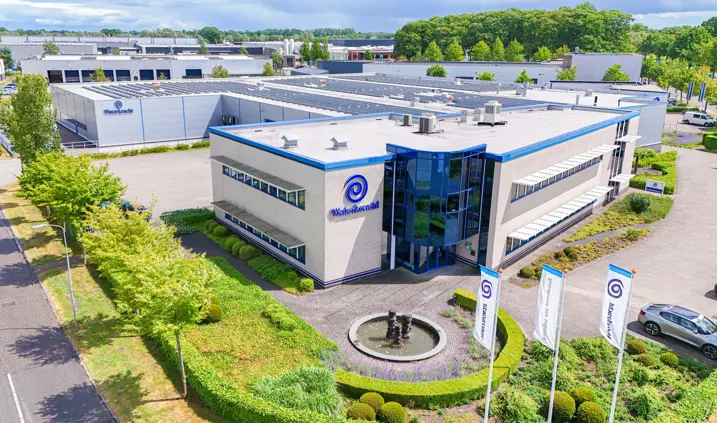
03 Waterkracht Building Varsseveld 3 14 Final
How our specialists select a high-pressure pump

A consultation rarely begins with the question of how many bar are required, but rather with the questions:

  • What do you want to clean?
  • What kind of dirt do you want to remove?
  • What result do you want to achieve?

The specialists at Waterkracht tailor a complete system to meet every cleaning requirement. In doing so, they ensure that the nozzle, operating pressure, water flow rate, drive system and high-pressure pump are all optimally matched. This results in a solution that is tailored to the type of soiling, the required productivity and the duration of use.